Floral Monogram Alphabet Embroidery
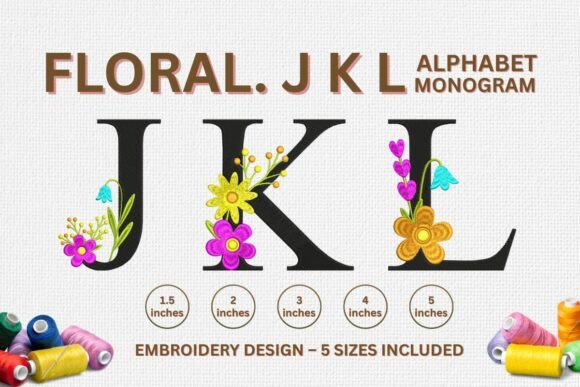
Floral Monogram Alphabet Embroidery is a curated digital design set that merges classic monogramming tradition with botanical artistry. Each letter—starting with J, K, and L in this collection—is digitized as a ready-to-stitch embroidery file, featuring hand-drawn floral motifs: delicate blossoms, winding vines, and layered foliage stitched in balanced density and thread-friendly detail. Unlike generic fonts or clip-art overlays, these designs are engineered for real-world machine performance—not just visual appeal. They’re part of a larger workflow where personalization meets precision, especially when time, consistency, and aesthetic cohesion matter.
Where It Fits in Your Creative or Business Process
This isn’t a standalone decoration—it’s a functional asset. Think of Floral Monogram Alphabet Embroidery as a modular component you deploy at specific inflection points: during product development (e.g., finalizing baby blanket samples), client onboarding (e.g., adding a custom initial to a boutique tote order), or brand rollout (e.g., stitching initials onto limited-edition merch). It sits between concept and execution: after you’ve defined your audience and before you press “start” on the hoop. Its value multiplies when aligned with planning stages—like choosing color palettes that match nursery themes or selecting fabric types that support fine stem stitches without puckering.
For small business owners, it integrates into inventory management systems by enabling batch customization without redesigning from scratch each time. For educators teaching textile arts, it serves as a scaffolded learning tool—students practice hooping, stabilizer selection, and color sequencing using pre-optimized files before advancing to original digitizing. For freelancers managing multiple clients, it reduces decision fatigue: instead of debating font styles for every project, they rely on a trusted, cohesive set that delivers consistent elegance across applications.
Five Sizes, One Seamless Workflow
The inclusion of five sizes—1.5”, 2”, 3”, 4”, and 5”—isn’t just about scaling; it’s about adaptability across physical constraints and functional intent. A 1.5” J works cleanly on a bib’s corner, while a 5” L anchors a nursery wall hanging. That range eliminates guesswork during layout: no more resizing mid-project and risking stitch distortion or thread tension issues. You choose the size based on your substrate, not your software.
Compatibility is built-in—not assumed. These files are tested across major formats (.dst, .pes, .jef, .exp, .vp3) and validated on machines from Brother, Janome, Bernina, and Husqvarna Viking. Before importing, verify your machine’s maximum hoop size and adjust accordingly: a 4” design fits comfortably in a 5x7 hoop, but pushing a 5” version into the same space may require re-hooping or switching to a larger frame. Always run a test stitch on scrap fabric first—especially with dense floral fills—to confirm stabilizer choice (cutaway works best for knits; tear-away suffices for stable cottons).
Practical Integration Across Use Cases
Nursery decor: Start early—embed initials into crib sheets, quilts, or wooden name signs *before* assembly. Since floral elements include subtle leaf trails, aligning them along seam allowances or pillow edges creates continuity. Group J, K, and L together for sibling sets, keeping size consistent across items for visual rhythm.
Personalized gifts: Build a repeatable gifting system. Store pre-sized files in clearly labeled folders (e.g., “Tote Bags – 3in”, “Pillows – 4in”) alongside matching thread charts. When a friend announces a baby, pull the 2” K file, pair it with soft pastel threads, and stitch directly onto organic cotton burp cloths—no design time needed.
Small-batch production: Use the 3” size as your default for most apparel items (onesies, tea towels, linen napkins). Keep a spreadsheet tracking which size was used per SKU and noting any adjustments (e.g., “L on denim required +10% top tension”). Over time, this becomes institutional knowledge—not anecdotal guesswork.
Preparation, Consistency, and Long-Term Usability
Preparation starts with organization—not just of files, but of context. Name your files descriptively: FloralMonogram_J_3in_PES, not letterJ_v2. Store backups in two locations: cloud-synced folder + external drive. Tag them in your asset library with keywords like “nursery,” “botanical,” “monogram,” and “machine-embroidery” so they surface during seasonal campaigns (e.g., spring baby collections).
Consistency hinges on calibration. Run a single test piece monthly—even if you haven’t used the files recently. Machines drift. Thread lots vary. Humidity affects fabric stability. A quick 2” J on muslin reveals tension shifts before they ruin a client’s heirloom pillow.
Long-term usability depends on how well the set scales with your growth. These designs avoid trendy micro-details (like ultra-thin stems or excessive satin stitch) that break down over repeated washing or commercial laundering. The floral elements use medium-density fill and clean jump stitches—designed to hold up across dozens of wash cycles on baby items or daily-use totes. That durability translates to fewer returns, fewer reworks, and stronger brand trust.
How It Interacts With Other Tools and Decisions
Floral Monogram Alphabet Embroidery doesn’t exist in isolation. It interacts directly with your stabilizer supplier (choose lightweight cutaway for stretchy fabrics), your thread vendor (match polyester threads to high-wear items), and your design software (use it to mirror or rotate letters—but avoid scaling beyond the provided sizes). It also informs purchasing decisions: if you regularly use the 5” size, investing in a 6x10 hoop becomes a logical next step.
For marketers, it supports storytelling—initials become entry points into narrative. A “K” stitched beside a watercolor kangaroo motif tells a story before words do. For bloggers documenting craft processes, showing side-by-side comparisons of the same J at 1.5” vs. 4” demonstrates scale intentionally—not as an afterthought.
Even educators use it to teach decision-making: students compare how the same floral L reads differently on burlap versus silk dupioni, then document why—leading to deeper understanding of material science, not just software clicks.
Implementation Tips You’ll Actually Use
- Batch prep saves time: Load all five sizes of J, K, and L into your embroidery software at once. Assign consistent thread colors across sizes so switching spools mid-project feels intuitive.
- Stabilize for the fabric, not the design: A dense floral fill on thin cotton needs more support than the same fill on canvas. Adjust stabilizer weight—not stitch count—when moving between substrates.
- Document your settings: Note machine-specific values (needle type, speed, tension) for each size/fabric combo. Reuse them next time instead of recalibrating.
- Leverage negative space: The floral elements leave intentional breathing room around letterforms. Use that space to add tiny coordinating motifs—like a single daisy near the base of the J—without altering the core file.
- Rotate for rhythm: On wide surfaces like wall hangings, rotate the K or L slightly (2–3 degrees) to echo natural vine movement—avoiding static, grid-bound layouts.
Floral Monogram Alphabet Embroidery works because it respects process: it assumes you’re balancing deadlines, quality standards, and creative vision. It doesn’t ask you to slow down—it gives you reliable, calibrated components so you can move faster without sacrificing intention. Whether you’re stitching one keepsake or producing fifty, the letters J, K, and L aren’t just initials. They’re waypoints in a thoughtful, repeatable, quietly elegant workflow.