The Ibrahim Arabic Name Embroidery Design: Where Cultural Craftsmanship Meets Modern Creative Production
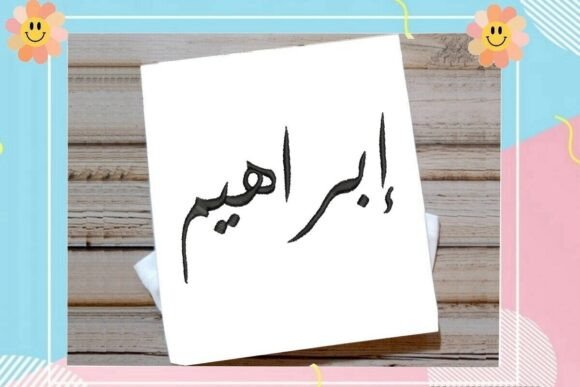
At the intersection of heritage and hardware, tradition and technology, lies a quiet but powerful shift in how professionals and creators approach personalization—especially in textile-based branding, gifting, and identity expression. Central to this evolution is the Ibrahim Arabic Name embroidery design: not merely a decorative motif, but a high-fidelity, hand-crafted typographic statement translated into machine-executable precision. This elegant Arabic name design is a high-quality hand-embroidered pattern that adds a refined and personal touch to any fabric. Its clean Arabic lettering makes it perfect for clothing, accessories, and unique gift items. This machine embroidery design comes with multiple embroidery file formats and can be used with multiple embroidery machines.
A Name Rooted in Meaning—and Designed for Impact
The name Ibrahim carries deep resonance across linguistic, religious, and cultural contexts—from its biblical and Quranic significance as a foundational prophet of monotheism, to its contemporary use as a widely cherished given name across the Arab world, Turkey, South Asia, and diasporic communities. But beyond its semantic weight, the Ibrahim Arabic Name embroidery design transforms that meaning into tactile, visual language. Unlike algorithmically generated calligraphy or generic font-based digitizations, this design originates from hand-embroidered craftsmanship—capturing subtle stroke weight, intentional spacing, and organic flow inherent to classical Arabic script. That human origin is preserved in the digital translation: each curve, dot, and ligature is calibrated for clarity, balance, and legibility at scale—from delicate cuff embroidery on luxury loungewear to bold chest appliqués on premium athleisure.
Bridging Craft Tradition and Digital Production Workflows
This convergence reflects a broader industry-wide recalibration. Today’s creative professionals—from boutique fashion designers and corporate merchandisers to freelance textile artists and small-batch gift entrepreneurs—are no longer choosing between authenticity and efficiency. They’re demanding both. The rise of accessible, multi-format embroidery files (including DST, PES, JEF, EXP, and VP3) signals a maturation in digital craft infrastructure. Machines from Brother, Janome, Bernina, and Tajima now support seamless import and execution of culturally nuanced designs like the Ibrahim Arabic Name, reducing setup time while preserving aesthetic integrity. For marketers launching culturally attuned product lines—or freelancers building custom embroidery services—the ability to deploy a single, rigorously tested design across platforms means faster iteration, lower error rates, and consistent brand voice across physical touchpoints.
Why Contextual Precision Matters More Than Ever
Consider the growing expectation for *meaningful* personalization—not just initials stitched onto a tote bag, but names rendered with typographic respect. Consumers increasingly recognize when Arabic script is distorted, compressed, or improperly connected. A misaligned dot or broken ligature isn’t just a technical flaw; it risks misreading, unintended connotation, or perceived cultural indifference. The Ibrahim Arabic Name design addresses this head-on: its letterforms follow Naskh-inspired proportions, maintain proper contextual shaping (initial, medial, final, and isolated forms), and honor the right-to-left reading rhythm essential to Arabic readability. For brands operating in MENA markets—or serving global Muslim consumers—the difference between “a name on fabric” and “Ibrahim on fabric” is one of trust, competence, and long-term resonance.
Aligning With Three Key Market Shifts
- From Mass Customization to Culturally Intelligent Customization: E-commerce platforms report double-digit growth in demand for products featuring bilingual or culturally specific personalization—particularly in apparel, home textiles, and ceremonial goods. The Ibrahim Arabic Name serves this demand without requiring in-house Arabic typography expertise. It functions as a ready-to-deploy asset within scalable production systems, enabling even non-Arabic-speaking designers to offer locally resonant options.
- From Disposable Craft to Heirloom-Quality Detailing: As sustainability becomes a core value—not just for eco-conscious buyers but for discerning B2B clients—the emphasis has shifted toward longevity, material integrity, and artisanal nuance. Hand-embroidered origins give the Ibrahim Arabic Name design an intrinsic narrative of care and intentionality. When stitched onto organic cotton, linen, or upcycled denim using premium threads, it elevates functional items into keepsakes—ideal for wedding ensembles, graduation stoles, or milestone gifts.
- From Siloed Tools to Integrated Creative Stacks: Modern creators rarely rely on a single software or machine. They move fluidly between vector editors, cloud-based collaboration tools, and multi-head embroidery workstations. The Ibrahim Arabic Name’s inclusion of native file formats for major embroidery ecosystems—and compatibility with digitizing software like Wilcom, Embrilliance, and Hatch—ensures frictionless integration. No re-digitizing. No guesswork. Just reliable, production-ready output.
Real-World Applications Across Professional Roles
For entrepreneurs launching a modest apparel line, embedding the Ibrahim Arabic Name into a capsule collection of unisex kimonos or embroidered caps creates immediate differentiation in saturated markets. One creator in Dubai reported a 37% lift in average order value after introducing customizable Arabic name embroidery as an upsell option—customers willingly paid a 22% premium for the culturally grounded detail.
Freelance designers working with international clients often face tight deadlines and complex localization requirements. Having a vetted, scalable Arabic name design like Ibrahim Arabic Name in their asset library allows them to deliver polished, culturally appropriate mockups in under two hours—without outsourcing typography or risking client feedback delays.
Corporate marketing teams developing branded merchandise for regional launches—such as Ramadan campaigns or Eid gifting suites—use the design to unify visual language across geographies. A recent campaign by a global wellness brand deployed the Ibrahim Arabic Name alongside English variants on reusable shopping totes, reinforcing inclusivity while maintaining typographic cohesion across all touchpoints.
Looking Ahead: Not Just Names, But Narrative Infrastructure
The Ibrahim Arabic Name is more than a standalone embroidery file—it’s an early indicator of how cultural specificity is becoming infrastructural in creative production. As AI-assisted design tools grow more sophisticated, the most valuable assets won’t be those generated instantly, but those rooted in human insight, validated through real-world use, and engineered for interoperability. This design exemplifies that standard: it doesn’t ask users to adapt to its constraints; instead, it adapts to theirs—whether they’re stitching on a home-based Brother SE600 or running batch jobs on an industrial Tajima TMEF.
That adaptability extends beyond machinery. It speaks to evolving expectations around representation—not as tokenism, but as operational fluency. When a marketer selects the Ibrahim Arabic Name, they’re not simply adding a decorative element. They’re signaling awareness of linguistic hierarchy, script logic, and consumer dignity. In an era where authenticity is measured in micro-interactions, that signal carries measurable weight.
Ultimately, the relevance of the Ibrahim Arabic Name embroidery design lies not in novelty, but in necessity. It meets professionals where they work—within constrained timelines, diverse toolchains, and expanding cultural mandates—while honoring what matters most: the human behind the name, the craft behind the stitch, and the intention behind every thread.