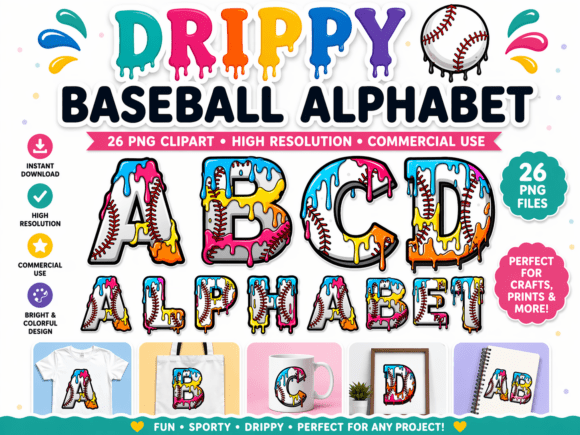
Colorful Drippy Baseball Alphabet A–Z
If you’ve ever tried to design a bold, playful baseball-themed shirt for a Little League team—or a vibrant birthday banner for a kid obsessed with home runs—you know how hard it is to find typography that’s both sporty and expressive. That’s where the Colorful Drippy Baseball Alphabet A–Z stands out: it’s not just another sports font. It’s a hand-crafted set of 26 high-detail PNG letters that fuse classic baseball stitching with glossy, gravity-defying paint drips—giving your designs instant energy, personality, and visual punch.
But here’s what many buyers overlook before downloading or printing: this isn’t a traditional font file you install in Photoshop or Canva. It’s a collection of individual, transparent-background PNGs—each letter carefully rendered with clean edges, layered textures, and intentional highlights. Confusing it with a downloadable font is the most common misstep—and it leads directly to wasted time, layout frustration, and mismatched expectations.
Why assuming it’s a font creates real workflow problems
Imagine dragging “A” into your design software expecting to type “Alex” automatically—only to realize you need to place each letter manually, adjust spacing by eye, and scale them individually. That’s not a flaw in the design—it’s a mismatch between expectation and format. Beginners often assume “alphabet set” means “typeable font,” especially when browsing marketplaces where fonts and graphic sets appear side-by-side. The result? Delayed projects, inconsistent sizing, and unnecessary layer adjustments.
A better approach? Treat each PNG like a precision sticker—not a keyboard input. Use alignment guides, lock aspect ratios when resizing, and build your word in stages: lay down the base letters first, then fine-tune kerning using visual rhythm (not software auto-spacing). For example, “TEAM” works best when the “E” and “A” sit slightly closer than the “M” does to the “A”—mimicking how real hand-painted signage breathes.
The transparency trap—and why resolution matters more than you think
All files include transparent backgrounds—that’s great… if your output medium supports it. But if you’re prepping files for sublimation on white polyester shirts, transparency is perfect. Print the same PNG onto kraft paper stickers without a white underbase? You’ll get faint, muddy drips because the brown paper absorbs the subtle gradients in the glossy drip effect. Likewise, low-resolution previews can hide pixelation at larger sizes—especially in the delicate drip tails or stitch lines.
Before committing to a large print run or cutting vinyl, always open one letter at full size (3000px wide) in your editor and zoom to 200%. Check that the drip edges stay smooth, the stitching texture remains crisp, and no halos or fringing appear around the letterform. If you see fuzziness, you’re likely viewing a compressed preview—not the actual high-res file. The Colorful Drippy Baseball Alphabet A–Z delivers true high-resolution PNGs, but only if you download the full package—not just the thumbnail bundle.
When “colorful” doesn’t mean “unlimited customization”
The set comes in fixed, vibrant colorways—think electric blue drips on crimson letters, lime green on navy, or sunset orange on charcoal. That’s intentional: the contrast makes the baseball stitching pop, and the saturation ensures visibility on fabric, stickers, and party decor. But some creators assume they can easily recolor the drips in Illustrator using Live Paint or Hue/Saturation sliders. Not quite.
Because the drips include layered gloss, shadow, and texture overlays, flat recoloring flattens depth and kills realism. Instead of forcing edits, choose the pre-matched colorway that aligns with your brand palette—or pair letters with complementary solid-color backgrounds (e.g., pair teal-drip “J” with a mustard-yellow banner). If full color control is essential for your business (say, matching a client’s exact PMS), this set may not be your primary tool—but it’s excellent for consistent, on-brand seasonal collections.
Real-world use cases where it shines—and where to pause
This alphabet excels where personality and immediacy matter most: custom name stickers for youth league gear, sublimated warm-up hoodies, digital scrapbook kits for baseball-themed baby showers, or planner stickers that turn “Practice” into a statement. Educators use it for classroom posters (“Strike Out Spelling!”); small-batch apparel sellers feature it on Etsy listings with lifestyle mockups—not flat white backgrounds—so shoppers instantly grasp its tactile, dimensional quality.
Where it’s less ideal? Long paragraphs, editorial layouts, or accessibility-first digital interfaces. The drips and textures reduce legibility at small sizes (<24px), and screen readers can’t interpret PNG text. So while it’s perfect for a t-shirt slogan or party banner headline, don’t use it for website navigation or printed instructions.
What to verify before buying or using
- File format: Confirm you’re getting PNGs—not EPS, SVG, or OTF. This set is raster-based, optimized for print and digital display—not scalable vector editing.
- License scope: Check if your intended use (e.g., selling physical products with the letters on them) is covered. Most versions allow commercial use, but resale of the PNGs as-is is typically prohibited.
- Consistency across letters: Open “B”, “O”, and “S” side-by-side. Do the drip directions flow naturally? Are stitch densities uniform? Inconsistent execution breaks visual trust—even if subtle.
- Background handling: Test one letter over light, dark, and patterned mockups. Does the drip retain contrast? Does the stitching disappear against busy textures?
Finally, take five minutes to explore how others use it—search Instagram or Pinterest for #drippybaseballfont or #baseballtypography. You’ll spot clever hacks: layering letters over distressed textures, using drip direction to imply motion in a logo, or pairing “HIT” with a baseball icon drawn at the same angle. Inspiration like that turns a simple asset into a signature style.
The Colorful Drippy Baseball Alphabet A–Z isn’t about shortcuts—it’s about intentionality. When you match its strengths (vibrant texture, sporty authenticity, ready-to-place clarity) with thoughtful application, it stops being just a download and becomes part of your creative voice.