Cottagecore Father’s Day Aesthetic: Weaving Warmth, Memory, and Intention into Meaningful Celebrations
The Cottagecore Father’s Day Aesthetic isn’t just a visual trend—it’s a quiet shift in how we honor fatherhood: less about grand gestures, more about grounded presence. It draws from pastoral simplicity, handmade warmth, and unhurried connection—think sun-dappled porches, shared gardening gloves, steaming mugs passed between generations, or a child perched on a father’s shoulders amid wildflower borders. This aesthetic doesn’t replace tradition; it deepens it. It meets people where they are: creators designing heartfelt cards, educators crafting classroom keepsakes, small business owners developing seasonal product lines, or parents assembling memory boxes with intention—not perfection.
At its core, the Cottagecore Father’s Day Aesthetic supports a values-driven workflow: one where emotional resonance matters as much as execution. It fits naturally into planning cycles—before a project begins (as mood reference), during creation (as stylistic anchor), and after delivery (as a consistency touchstone for future iterations). Unlike generic clipart, this aesthetic carries narrative weight. A vintage-style lantern illustration doesn’t just fill space—it evokes evening walks, shared stories, and safety. A hand-drawn bicycle with a wicker basket signals freedom, exploration, and gentle guidance. These aren’t decorative add-ons; they’re emotional infrastructure.
How It Integrates Into Real Creative and Business Workflows
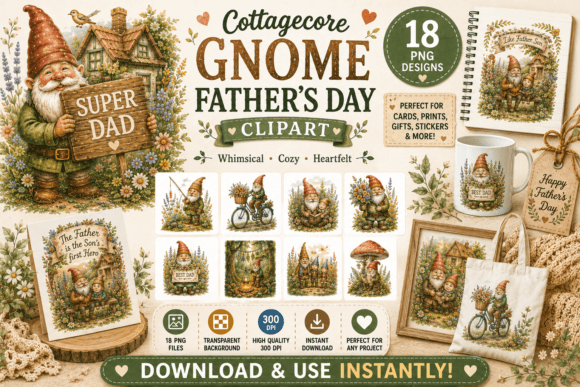
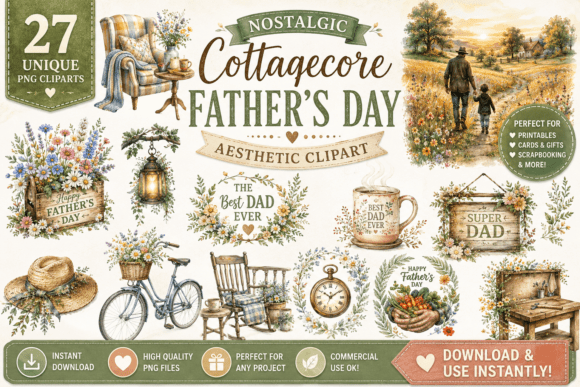
For digital designers and print-on-demand sellers, the Cottagecore Father’s Day Aesthetic functions as both asset and filter. Before sourcing or commissioning illustrations, many use mood boards built around this aesthetic to align stakeholders—clients, team members, or collaborators—on tone and texture. The 27-piece clipart bundle becomes a ready-made palette: each element calibrated for cohesion. You don’t need to adjust saturation, contrast, or line weight across files—the vintage textures and natural tonal range are consistent by design. That saves time in post-production and reduces revision loops.
In education or community programming, this aesthetic supports inclusive storytelling. Teachers integrating it into Father’s Day journals or family history projects find it resonates across diverse family structures—grandfathers, stepfathers, uncles, mentors—because its focus is on care, not rigid roles. The father-and-child moments included aren’t prescriptive; they’re open-ended: a pair tending seedlings, sketching side-by-side, or reading under a quilt-draped oak. That flexibility allows personalization without extra design labor.
For small business owners running Etsy shops or local craft fairs, compatibility is critical. These PNGs work seamlessly across platforms: uploaded directly into Canva for social graphics, layered into Procreate for custom sticker sheets, or imported into Cricut Design Space for vinyl cut files. The transparent backgrounds eliminate clipping masks or manual erasing—especially valuable when scaling across product types (mugs, tea towels, greeting cards). And because all files are 300 DPI, there’s no guesswork when moving from screen mockups to physical prints.
Practical Implementation: From Selection to Delivery
Start with purpose—not aesthetics alone. Ask: What feeling do I want the recipient to carry away? If it’s comfort, lean into rocking chairs, quilts, and steaming mugs. If it’s legacy, prioritize gardening tools, handwritten notes, or weathered signs. Use the bundle’s thematic groupings (countryside scenes, floral arrangements, rustic signage) as functional categories—not just visual ones.
Organization matters. Rename files meaningfully before importing: “cottagecore-father-child-gardening-01.png” instead of “image_17.png”. This pays off later when building templates or reusing assets across seasons. Many users create a master folder with subfolders labeled by use case—“Cards”, “Sublimation”, “Wall Art”—and drop optimized versions (e.g., resized for Instagram Stories or cropped for mug wraps) into each. Consistency here prevents duplication and speeds up repeat projects.
Quality control is embedded in the bundle’s construction: AI precision ensures clean vectors and scalable clarity, while human touch guarantees subtle imperfections—slight ink bleed, paper grain overlay, soft watercolor edges—that signal authenticity. When layering elements (say, a lantern over a floral wreath), match texture intensity. Pair a heavily textured mug with a lightly grained background—not a stark white one—to preserve visual harmony. Test prints early: what reads warmly on screen can flatten in ink. A quick 4×6 test print reveals how tones hold up on matte vs. glossy stock.
Long-Term Use and Cross-Project Efficiency
This aesthetic isn’t seasonal window dressing—it’s reusable infrastructure. Elements like vintage floral borders, rustic frames, or botanical motifs appear across Mother’s Day, wedding invites, or autumn journaling kits. With thoughtful naming and tagging (e.g., adding “cottagecore-border” or “farmhouse-frame” to file metadata), you build a searchable internal library that grows in value over time.
Efficiency compounds when combining assets. One user reported cutting card design time in half by building a base template in Illustrator: fixed layout, pre-placed typography zones, and drag-and-drop slots for interchangeable clipart. They swapped out a bicycle for a rocking chair or swapped lavender sprigs for daisies depending on the recipient’s personality—all without rebuilding from scratch.
For teams or collaborative workflows, share a style guide excerpt alongside the bundle: note the primary color anchors (oatmeal, sage, terracotta), recommended font pairings (serif headers + gentle sans-serif body text), and spacing rules (e.g., “always leave 12pt breathing room around illustrated elements”). That maintains cohesion across contributors—whether it’s a freelancer handling social visuals or an intern updating website banners.
Final Considerations for Thoughtful Execution
Remember: the strength of the Cottagecore Father’s Day Aesthetic lies in restraint. Overloading a card with six different elements dilutes impact. Choose one focal illustration—a father-and-child moment—and support it with minimal typography and ample negative space. Let the warmth breathe.
Also consider accessibility. While soft tones evoke calm, ensure sufficient contrast between text and background overlays—especially for printed materials used by older recipients. A quick check in browser dev tools or using a free contrast checker takes seconds and broadens reach.
Finally, treat these illustrations as collaborators—not shortcuts. Their nostalgic texture invites slowness, reflection, and care. That intention transfers to the final piece. Whether it’s a hand-assembled scrapbook page, a limited-run T-shirt series, or a classroom display board, the aesthetic becomes part of the message: Fatherhood, like cottagecore itself, is rooted in patience, presence, and quiet, enduring love.