55 BOLD and EASY SPACE COLORING PAGES
If you're looking for space-themed coloring resources that actually work well—whether for classroom use, therapeutic activities, KDP publishing, homeschooling, or creative downtime—you’ll want to pay close attention to what 55 BOLD and EASY SPACE COLORING PAGES delivers—and what many buyers overlook before downloading or printing.
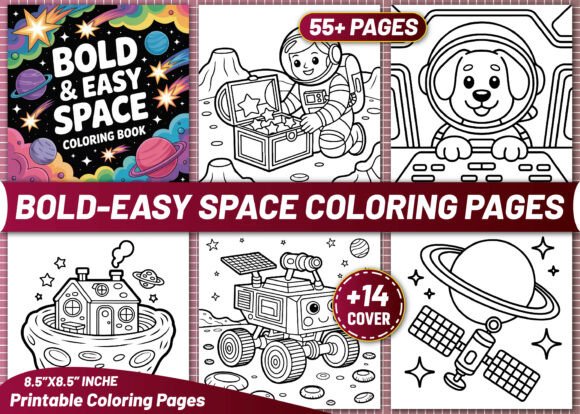
This collection isn’t just another generic set of outer space clipart or thin-lined illustrations. It’s intentionally designed with usability in mind: thick outlines, generous spacing between elements, minimal internal detail, and consistent 8.5″ × 8.5″ sizing across all 55 pages. That means less frustration for young children learning fine motor control—and fewer redrawn lines or color bleed-throughs for adults using markers, gel pens, or digital styluses.
Common Mistakes People Make With Space Coloring Pages
Many users assume “space coloring pages” are interchangeable—especially when browsing marketplaces like Etsy or Amazon KDP. But not all space-themed designs serve the same purpose. Here’s where things often go sideways:
- Assuming “bold” means “visually striking” instead of “thick, colorable outlines.” Some listings use “bold” as a marketing buzzword—but deliver medium-weight lines (1–1.5 pt) that still challenge toddlers or those with developing hand-eye coordination. In contrast, the 55 BOLD and EASY SPACE COLORING PAGES use consistently heavy outlines (often 3–4 pt), verified at 300 DPI, so printed or zoomed-in versions retain clarity.
- Overlooking file format flexibility. A single PDF might look fine on screen, but if you need SVG files for Cricut or Silhouette projects—or high-res PNGs for digital coloring apps—you’ll hit limits fast. This collection includes all four formats (PDF, JPG, PNG, SVG), each optimized for its intended use—not just bundled as an afterthought.
- Misjudging scale and layout. Some space coloring books cram planets, rockets, and astronauts onto one page with tight spacing. That makes it hard to color without going outside lines—or worse, causes confusion for early learners who can’t yet distinguish overlapping shapes. These pages keep subjects isolated or gently grouped, with breathing room built into every design.
Why Format & Resolution Matter More Than You Think
A 72 DPI JPEG may load quickly online—but it won’t hold up when printed at full size or scaled for large-format posters. Worse, low-resolution files often pixelate when traced in design software, leading to jagged edges in final products. The 55 BOLD and EASY SPACE COLORING PAGES ship at true 300 DPI across all formats. That’s non-negotiable if you’re preparing interiors for KDP paperback uploads, creating laminated classroom handouts, or exporting assets for Procreate brushes.
And here’s something most listings don’t clarify: SVG files aren’t automatically “editable” unless they’re cleanly layered and ungrouped. Some sellers export flattened vector art that resists recoloring or resizing. These SVGs are structured with named layers and ungrouped paths—so you can easily change rocket colors, hide stars, or isolate constellations for lesson plans.
What Educators and Creators Should Check Before Use
Before assigning these to students—or integrating them into your next product—verify three practical details:
- Test print one page at actual size. Don’t rely on screen previews. Print a sample on standard 8.5″ × 11″ paper (centered) to confirm margins, line thickness, and spacing feel right for your audience’s age or skill level.
- Open the SVG in your vector editor. Try ungrouping and selecting individual elements (e.g., the moon vs. craters). If everything selects as one block, editing will be slow and imprecise. These files let you modify parts independently—ideal for customizing lesson visuals or building themed activity kits.
- Scan the cover options against your brand or platform requirements. The 14 premium book cover images include clean, scalable layouts—with and without title text—so you can match KDP’s spine width specs or adapt for Canva templates without cropping critical artwork.
Better Choices Start With Clear Expectations
It’s easy to gravitate toward the lowest price or flashiest preview image—but long-term value comes from consistency, adaptability, and thoughtful design. For example, one educator bought a cheaper 60-page pack only to find 17 pages reused the same rocket outline with minor tweaks. That created repetition fatigue in her after-school program. With 55 BOLD and EASY SPACE COLORING PAGES, every illustration is unique: a smiling Saturn with rings, a friendly astronaut floating near Earth, a simplified solar system chart, even a cute alien holding a star map—all drawn with equal care and visual weight.
Similarly, creators building digital products sometimes skip checking whether included solutions (answer keys or colored examples) match the line art exactly. Misaligned solutions cause confusion during guided sessions or reduce perceived professionalism in paid courses. These pages include verified, on-brand solution sheets—each matching the corresponding line drawing in layout, orientation, and naming.
Final Thought: Match the Tool to Your Real Work
Whether you’re designing a printable space unit for kindergarten, launching your first KDP coloring book, or assembling a calming toolkit for neurodiverse teens—what matters isn’t how many pages you have, but how reliably each one supports your goal. Thick lines prevent smudging. Generous spacing reduces overwhelm. Multiple formats mean no last-minute conversions. And 300 DPI ensures your effort translates cleanly—on paper, screen, or vinyl.
The 55 BOLD and EASY SPACE COLORING PAGES reflect that balance: simple enough for beginners, sturdy enough for professionals, and versatile enough to grow with your needs—without requiring extra editing, scaling, or troubleshooting.