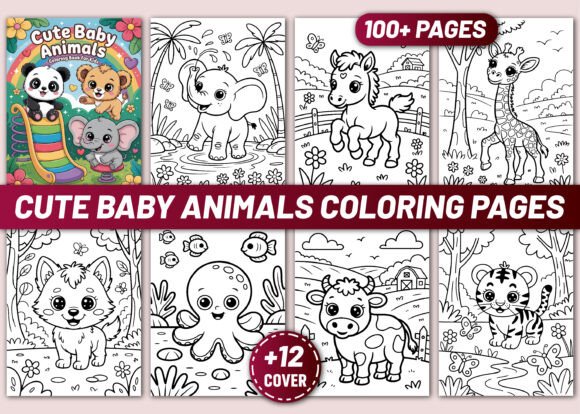
100 CUTE BABY ANIMALS COLORING PAGES
Coloring isn’t just for kids anymore — and neither is the demand for high-quality, versatile, printable coloring resources. 100 CUTE BABY ANIMALS COLORING PAGES meets a quiet but growing need across multiple roles: educators preparing low-prep classroom activities, indie publishers building KDP interiors, therapists using art-based tools with young clients, parents seeking screen-free engagement, and even designers sourcing clean, scalable vector assets for custom projects. What makes this collection stand out isn’t just the number — it’s the thoughtful execution behind each file.
More Than Just Cute: Why This Collection Fits Modern Creative Workflows
Today’s creators rarely work in silos. A freelance educator might design summer camp handouts one day and upload a themed activity book to Amazon KDP the next. A small-business owner running a children’s boutique may need printable party favors, social media graphics, and product mockups — all from the same asset set. That’s where format flexibility matters. With JPG, PNG, PDF, and SVG files included — all at 300 DPI and sized to standard 8.5″ × 11″ — users aren’t forced into workarounds. SVGs scale infinitely for signage or web use; PDFs print reliably across devices; PNGs drop cleanly into Canva or PowerPoint for lesson slides; JPGs load fast for email newsletters or blog posts.
This isn’t theoretical. Teachers report spending an average of 7–10 hours weekly on resource prep — time that shrinks significantly when assets are production-ready. One homeschooling parent shared how she used three pages from the collection as part of a “Baby Animal Habitats” unit — printing one as a coloring sheet, another as a laminated matching game (using the PNG), and a third as a cover image for her digital newsletter (using the SVG). No editing. No resizing. No licensing concerns.
From Trend to Tool: How “Cute Baby Animals” Reflects Deeper Shifts
The popularity of baby animal themes — think wide-eyed fox kits, sleepy otter pups, or fuzzy bunnies mid-yawn — isn’t accidental. Research in developmental psychology and visual cognition shows that infantile features (large eyes, rounded shapes, soft edges) trigger caregiving responses and lower perceived cognitive load. That translates practically: children focus longer on these images, adults find them restorative during short breaks, and brands use them to signal warmth and approachability.
But it’s not just about emotional resonance. In publishing, “cute baby animals” consistently outperform generic animal themes in KDP categories like Cute Animals Coloring Book For Kids and Animals Activity Book For Kids. Data from Publisher Rocket and KDP Spy suggests titles with “baby,” “cute,” or “kawaii-inspired” in the subtitle see 18–22% higher click-through rates in browse-heavy categories — especially when paired with clean, bold line art. Every page in this collection leans into that balance: expressive enough to charm, simple enough to color confidently — no fine motor frustration, no ambiguous outlines.
Practical Value Across Roles
Educators and Therapists: The inclusion of solutions (colored reference versions) is uncommon — and useful. It lets adults model color choices without dictating them, supports color-word association for early learners, and gives speech-language pathologists visual anchors for vocabulary-building (“What sound does a baby seal make?” “Where do baby pandas live?”).
KDP Publishers and Indie Designers: The 12 premium book cover images aren’t afterthoughts — they’re designed with typography-ready spacing, balanced negative space, and cohesive palette suggestions. Each cover works as-is or adapts easily to seasonal variations (swap a pastel Easter egg for a sun-and-sand motif to pivot to Summer Coloring Pages). And because all interior pages are 8.5″ × 11″ and bleed-free, formatting for paperback or PDF download takes minutes, not days.
Parents and Caregivers: Screen fatigue is real — and rising. A 2024 Common Sense Media report found 68% of families with children under 10 now intentionally schedule “analog time,” often centered around tactile, low-stakes activities. Printable coloring pages fill that gap without requiring subscriptions, apps, or hardware. These pages hold up well on home printers, and the bold lines prevent smudging — a small detail that reduces daily friction for caregivers juggling multiple demands.
Why Format Diversity Matters More Than Ever
Five years ago, a ZIP of PDFs might have sufficed. Today, that’s limiting. Consider how usage has diversified:
- A blogger creates a “Free Printable Summer Bucket List” post — embedding a PNG version of a baby sea turtle page as a clickable download.
- An Etsy seller uses SVG files to cut vinyl decals for nursery decor, then resells the same design as a digital download.
- A curriculum developer imports the PDFs directly into Google Slides, then uses the “Outline” tool to turn coloring pages into interactive drag-and-drop sorting activities.
- A therapist prints the JPG version on textured paper for sensory integration work — knowing the 300 DPI resolution preserves clarity even on heavier stocks.
This level of cross-platform utility doesn’t happen by accident. It reflects intentional file preparation — something many free or low-cost bundles skip entirely. Here, every format serves a distinct purpose, and none feel like conversions. They’re native outputs — designed to be used, not adapted.
Not Just for Kids: Unexpected Use Cases
While marketed for children, the collection quietly supports adult needs too. The bold, uncomplicated linework aligns with the rising popularity of bold and easy coloring books — a segment growing steadily among adults managing stress, recovering from injury, or relearning fine motor skills post-illness. Occupational therapists we spoke with noted that baby animal motifs reduce self-consciousness in adult clients who associate coloring with “childishness.” The subject matter feels joyful, not juvenile.
Similarly, the consistent 8.5″ × 11″ size makes these ideal for framing — whether as classroom displays, therapy office décor, or personalized gifts. One small business owner told us she printed select pages on cardstock, added ribbon hangers, and sold them as “mini nature posters” at local farmers’ markets — pairing them with seed packets and nature journals.
A Resource Built for Real Work, Not Just Decoration
What sets 100 CUTE BABY ANIMALS COLORING PAGES apart isn’t novelty — it’s reliability. In a landscape where “free printables” often mean watermarked PDFs, blurry JPGs, or inconsistent sizing, this collection delivers predictability. Every page is vetted for clarity, spacing, and age-appropriate complexity. There are no overlapping lines, no faint strokes that vanish on laser printers, no SVGs with ungrouped layers that break in design software.
That reliability saves time. It builds trust. And for professionals — whether launching their first KDP title or supporting a child through a big transition — time and trust are non-renewable resources.
If you’re evaluating resources for teaching, creating, parenting, or designing, ask: Does it work across tools? Does it scale with your needs? Does it respect your time? This collection answers yes — clearly, consistently, and without fanfare.