Retro Cottagecore Kitchen Clipart: Warm, Timeless Visuals for Modern Creative Work
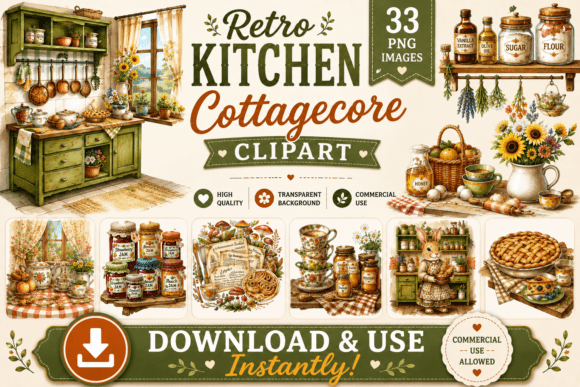
There’s a quiet shift happening in how we design, document, and decorate—not toward sleek minimalism or hyper-digital futurism, but toward warmth, intention, and tactile memory. Retro Cottagecore Kitchen Clipart sits at the heart of this movement: a curated collection of 30 high-resolution PNG files that evoke the soft light, hand-stitched charm, and unhurried rhythm of 1970s farmhouse kitchens—without nostalgia as mere decoration. It’s visual language with purpose: gentle color palettes, carefully rendered teacups with faint steam lines, jam jars labeled in vintage serif, recipe books with slightly curled corners, and pantry shelves stocked with linen sacks and ceramic crocks. These aren’t generic “vintage” graphics. They’re designed with contextual authenticity—thoughtful proportions, subtle texture overlays, and intentional imperfections that signal care, not age.
Why This Aesthetic Resonates—Now More Than Ever
People aren’t just seeking retro visuals—they’re seeking resonance. The rise of cottagecore wasn’t accidental; it responded to real-life pressures: information overload, fragmented attention, and a growing desire for grounded, sensory-rich experiences. What began as an online aesthetic has matured into a practical creative framework—especially in spaces where people make, share, and preserve meaning: kitchens, journals, small-batch product packaging, and handmade goods. The 70s iteration of cottagecore adds another layer: less pastoral fantasy, more lived-in realism—think avocado-green appliances beside woven baskets, floral wallpaper behind open shelving, handwritten recipe cards tucked between flour-sack towels. That specificity matters. It tells a story audiences recognize—not as escapism, but as continuity.
This is why Retro Cottagecore Kitchen Clipart feels timely. It meets creators where they are: balancing digital workflows with analog sensibilities. A food blogger designing a printable meal planner doesn’t need photorealistic stock photos—they need flexible, layered elements they can resize, recolor, and rearrange without losing warmth. A small-batch candle maker launching a “Hearth & Honey” line needs cohesive sublimation-ready graphics for mugs and tea towels—not generic clipart that reads as mass-produced. The bundle delivers precisely that: commercial-use-ready assets built for integration, not imitation.
Practical Use Across Real-World Projects
The strength of this collection lies in its functional versatility—not just its aesthetic appeal. Each PNG file features a transparent background, enabling seamless layering in Canva, Adobe Illustrator, Procreate, or even free tools like Photopea. That technical detail unlocks real efficiency:
- Recipe journals and cookbooks: Layer illustrated mixing bowls over handwritten ingredient lists or use vintage recipe book icons as section dividers—adding narrative cohesion without distracting from content.
- Junk journals and scrapbooking: Combine teacup illustrations with scanned fabric swatches or dried flower scans to build tactile, dimensional pages that feel collected over time—not assembled digitally.
- Farmhouse wall art and printables: Scale a single jam jar graphic to poster size, pair it with a muted sage or buttercream background, and you’ve got gallery-worthy kitchen decor—no photographer or printer required.
- Print-on-demand and sublimation: Because files are high-resolution (300 DPI) and cleanly isolated, they translate reliably onto aprons, ceramic mugs, and linen napkins—retaining detail even at larger sizes.
- Digital stationery and planners: Use pantry shelf illustrations as headers for weekly grocery lists, or embed tiny rolling pins and whisk icons into habit trackers—small visual cues that reinforce theme and intention.
What sets this bundle apart from broader “vintage kitchen” collections is its consistent palette and stylistic restraint. The warm retro cottage palette—think oat milk whites, faded terracotta, sage greens, and dusty rose—was chosen deliberately. It avoids clashing with modern neutrals while still feeling distinct. You won’t find oversaturated yellows or jarring contrasts here. Instead, there’s harmony: colors that sit comfortably beside natural wood grain, unbleached cotton, or matte ceramic finishes.
Evolving Beyond Trend—Toward Intentional Design
Early cottagecore graphics often leaned heavily on floral borders and fairy lights—charming, but sometimes superficial. Today’s most effective iterations prioritize authenticity of detail: the slight warp in a wooden spoon handle, the uneven glaze on a stoneware mug, the way light catches the rim of a glass measuring cup. This bundle reflects that evolution. Its 70s farmhouse references aren’t caricatures—they’re researched, refined, and rendered with quiet confidence. That level of craft signals respect—for the viewer’s discernment, for the history being referenced, and for the creator’s time.
For professionals—freelance designers, POD entrepreneurs, educators creating classroom cooking resources, or bloggers building branded digital products—this means less time sourcing, editing, or apologizing for mismatched styles. It means consistency across touchpoints: the same teacup icon appears on a printable menu, a sticker sheet, and a tote bag design, reinforcing brand identity through visual repetition rather than forced slogans.
Designing With Integrity—Not Just Aesthetics
Using Retro Cottagecore Kitchen Clipart thoughtfully also invites reflection on *why* certain visuals endure. A handwritten recipe isn’t just charming—it represents knowledge passed down, adjustments made by hand, margins filled with notes. A mason jar full of dried lavender speaks to preservation, seasonality, and care. When these motifs appear in your work, they carry quiet weight. That’s especially valuable in markets where consumers increasingly favor small businesses rooted in values—sustainability, craftsmanship, transparency. Your choice of illustration isn’t neutral. It’s part of your story.
That said, authenticity requires balance. Pairing these graphics with overly clinical copy or sterile layouts dilutes their impact. Let them breathe: use generous white (or cream) space, choose typefaces with organic contrast (like a warm serif for headings and a gentle sans for body text), and avoid stacking too many elements at once. These illustrations thrive in simplicity—not clutter.
Getting Started—Without Overcomplicating
You don’t need advanced design skills to benefit from this bundle. Start small: download one file—a linen-textured recipe card template or a set of three jam jar icons—and drop it into a project you’re already working on. Notice how it changes the tone. Does it soften a sharp layout? Add warmth to a functional worksheet? Invite closer looking? That’s the quiet power of considered visual language.
As workflows continue blending digital speed with analog soul, tools like Retro Cottagecore Kitchen Clipart become more than decorative assets. They’re bridges—between past and present, digital and tactile, efficiency and meaning. They remind us that good design doesn’t shout. It settles in, feels familiar, and leaves room for the human hand to finish the work.