Front Back Two Mug Coffee Cup Mockup 30
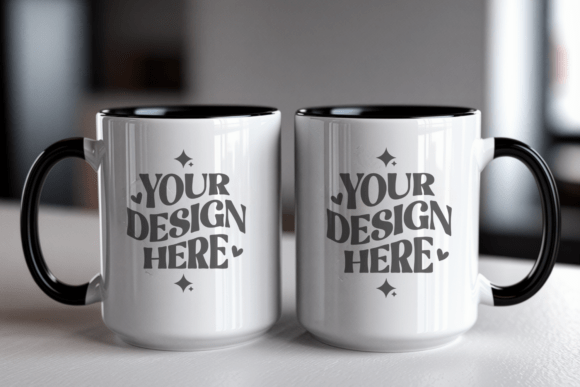
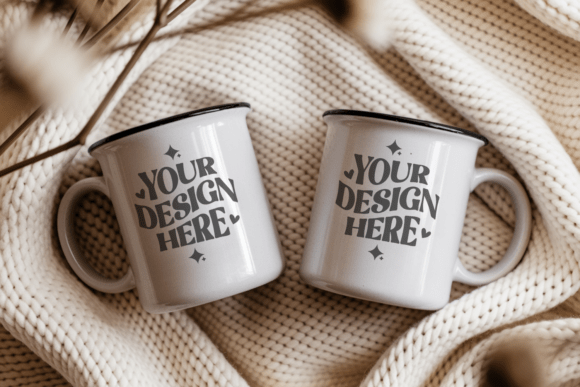
Front Back Two Mug Coffee Cup Mockup 30 is a high-fidelity, editable PSD file designed to showcase custom designs on two standard 11oz white ceramic mugs — each viewed from both front and back angles. It’s not just a static image; it’s a production-ready tool built for designers, print-on-demand sellers, marketers, and small business owners who need to present mug artwork with realism, speed, and consistency. Unlike generic cup templates, this mockup includes layered Smart Objects that accept your design files directly — no manual warping, perspective adjustments, or guesswork required.
Where This Mockup Fits in Your Creative or Business Workflow
Think of Front Back Two Mug Coffee Cup Mockup 30 as a bridge between concept and client or customer. Before launching a new mug design, you’ll use it to preview how colors, typography, and layout translate onto actual product surfaces — catching alignment issues or bleed concerns early. During a branding project, it helps align stakeholders by visualizing how logo variations perform across dual mugs in a cohesive set. After finalizing a design, it becomes the foundation for storefront listings, social media ads, email campaigns, and pitch decks. Its dual-mug composition supports storytelling: showing matching sets, complementary themes, or before-and-after comparisons without needing multiple assets.
How It Integrates With Real Tools and Platforms
This mockup works natively inside Adobe Photoshop (CS6 and newer), leveraging Smart Object layers that preserve your original design’s vector or raster integrity. You paste your artwork into the designated layer, save, and the mockup automatically applies realistic lighting, curvature, and subtle ceramic texture. No plugins or third-party scripts are needed. For teams using Figma or Canva, export your design as a high-res PNG first, then drop it into the Smart Object — the workflow remains frictionless.
For POD sellers using platforms like Printful, Redbubble, or Teespring, Front Back Two Mug Coffee Cup Mockup 30 streamlines listing creation. Instead of uploading raw designs and hoping the platform’s auto-preview reflects your intent, you generate polished, lifestyle-adjacent visuals that build trust and increase conversion. Pair it with stock photos of hands holding mugs (a common variant included in related bundles) to add human context — especially effective for Etsy or Shopify product pages where emotional resonance drives purchase decisions.
Practical Implementation Tips for Consistency and Efficiency
Start by organizing your design files with clear naming conventions: “Mug_Front_Design_v2.psd”, “Mug_Back_Slogan_Final.png”. That way, when you open Front Back Two Mug Coffee Cup Mockup 30, you can quickly locate and replace each Smart Object without scrolling through cluttered layers. Keep a master folder with subfolders for “Source Art,” “Mockup Outputs,” and “Client Approvals” — this structure scales whether you’re producing one mug series or managing dozens for seasonal drops.
When preparing for client review, render both JPG and PNG versions. Use JPG for email previews (smaller file size, universal compatibility) and PNG with transparency for presentations or layered composites. Always export at 300 DPI and full resolution — even if the final use is digital — because clients often request print-ready assets later. And don’t skip soft-proofing: enable Photoshop’s “Proof Colors” (View > Proof Setup > Working CMYK) to simulate how your design will appear when printed on ceramic substrates, especially near edges or fine text.
Quality Control and Long-Term Usability
The clean white background and neutral lighting in Front Back Two Mug Coffee Cup Mockup 30 aren’t just aesthetic choices — they support accurate color evaluation and reduce post-production editing time. That said, don’t assume automatic fidelity. Always check how your design interacts with the mug’s curvature: text wrapping too tightly around the handle may become illegible, and centered logos can visually shift when applied to the curved surface. Zoom in to 100% and scan the seam where front meets back — ensure no pixel misalignment or halos appear along the mug’s contour line.
Over time, treat this mockup as a living asset. Save versioned copies (e.g., “FB_TwoMug_Mockup_v2_2024.psd”) whenever you update lighting presets, add shadow variants, or include alternate mug orientations. If you frequently work with different mug sizes, keep a reference sheet noting which mockups correspond to 11oz vs. 15oz dimensions — Front Back Two Mug Coffee Cup Mockup 30 is optimized for 11oz, but its layer structure makes adaptation to other sizes feasible with minor scaling adjustments.
Use Cases Across Roles and Goals
- Graphic designers: Use it during discovery calls to demonstrate how a brand’s color palette translates across physical products — helping clients visualize beyond screens.
- Sublimation sellers: Preview how gradients and fine details hold up under heat transfer by testing your design in the mockup before running a test press.
- Educators and bloggers: Embed rendered mockups in tutorials to illustrate proper placement zones, safe margins, and bleed areas — turning abstract guidelines into tangible examples.
- Small business owners: Build consistent visual language across Amazon listings, Instagram carousels, and packaging inserts using the same base mockup — reinforcing brand recognition without redesigning every time.
- Freelancers: Include a branded mockup variant (e.g., subtle watermark or corner logo) in your delivery package — adding perceived value while protecting your work.
Preparing for Smooth Integration
Before opening Front Back Two Mug Coffee Cup Mockup 30, ensure your system meets basic requirements: Photoshop installed, sufficient RAM (8GB minimum), and adequate scratch disk space. If you’re collaborating remotely, share the PSD with embedded Smart Objects — avoid flattening layers unless absolutely necessary. For cloud-based workflows, store the master file in Dropbox or Google Drive with version history enabled, and share links rather than attachments to prevent outdated copies circulating.
Also consider your output pipeline. If you regularly generate social thumbnails, create an action in Photoshop that exports a cropped 1080x1080 version with sharpening applied. If you send files to clients via email, compress final JPGs using “Save for Web (Legacy)” with quality set to 80–90 — balancing clarity and load time. These small habits compound: what takes 30 seconds per file adds up to hours saved over dozens of projects.
Final Observation: It’s About Clarity, Not Just Aesthetics
Front Back Two Mug Coffee Cup Mockup 30 succeeds not because it looks polished — though it does — but because it removes ambiguity. When a client sees their design on two mugs, front and back, in natural lighting, they’re not imagining possibilities. They’re evaluating a concrete outcome. That clarity accelerates feedback loops, reduces revision rounds, and strengthens confidence in your process. Whether you’re iterating on a single design or managing a catalog of mug SKUs, this mockup functions as infrastructure — quiet, reliable, and always ready to turn intention into presentation-ready reality.