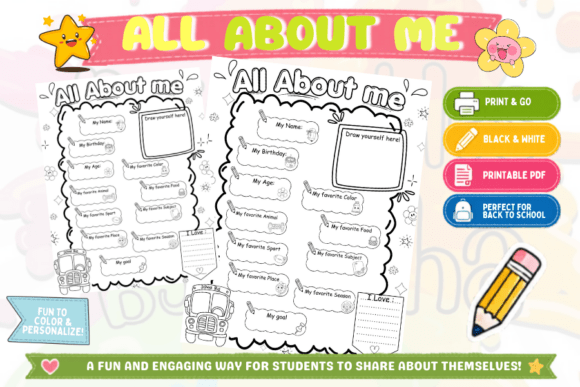
FREEBIES Back to School Activity: A Practical Tool for Building Community from Day One
Starting the school year with intention matters—not just for student engagement, but for how smoothly classroom systems settle into place. The FREEBIES Back to School Activity, specifically the All About Me Worksheet, isn’t just a “first-week filler.” It’s a low-lift, high-impact entry point into relationship-building, self-awareness development, and foundational literacy practice—all in one print-and-go resource. Used deliberately, it supports transitions, informs instructional planning, and reinforces routines before formal curriculum ramps up.
Where This Fits in Your Back-to-School Workflow
Think of the FREEBIES Back to School Activity as part of your onboarding sequence—not an isolated task, but a connective thread between administrative setup, community norms, and academic readiness. Most educators begin August with supply prep, seating charts, and schedule mapping. That’s the structural layer. The All About Me Worksheet operates at the human layer: it surfaces individuality before assumptions take root. You don’t need to wait until Day 1 to use it. In fact, integrating it into your pre-planning phase helps you anticipate needs—like noticing a student lists “drawing” as their favorite activity and planning early visual supports, or spotting multiple students naming soccer as their favorite sport and building collaborative movement breaks into morning meetings.
How It Works Before, During, and After the First Week
Before school starts: Print and organize copies by class or group. Consider pairing the worksheet with a short video message or welcome note asking students to complete one section (e.g., “My Name,” “My Goal”) ahead of time—especially useful for hybrid or asynchronous start weeks. This primes ownership and reduces first-day cognitive load.
During the first three days: Use the worksheet in staggered 15–20 minute blocks—not all at once. Start with “Draw Yourself” and “My Name” on Day 1 (fine motor warm-up + identity affirmation), add “My Favorite Color” and “My Favorite Animal” on Day 2 (vocabulary + descriptive language), then move to “My Goal” and “I Love…” on Day 3 (goal-setting mindset + emotional literacy). This pacing respects attention spans while building stamina.
After the first week: Leverage completed worksheets as living resources—not just bulletin board decor. Scan and file digitally by student name for quick reference during parent conferences. Pull quotes (“I love helping my little brother”) to personalize behavior plans or IEP notes. Use anonymized responses (“Three students said their favorite subject is science”) to guide small-group interest surveys or choice-based learning stations.
Integration With Other Tools and Systems
The strength of the FREEBIES Back to School Activity lies in its interoperability. It doesn’t replace your SEL curriculum—it complements it. Pair “My Goal” with your existing growth-mindset anchor charts. Connect “My Favorite Place” to geography or descriptive writing units later in September. Use “My Birthday” and “My Age” to launch data collection lessons (bar graphs, tally marks) without needing new materials.
It also interfaces cleanly with digital tools. Snap a photo of each completed worksheet and upload to your LMS (Google Classroom, Seesaw) with a voice note prompt: “Tell us one thing about your drawing.” That transforms static paper into multimodal expression. For teachers using behavior tracking apps like ClassDojo, pull descriptors from “I Love…” to reinforce positive behaviors (“Maya loves reading—let’s celebrate her focus during independent reading time”).
Practical Implementation Tips for Real Classrooms
- Prepare for variability: Keep blank versions on hand for students who need sentence starters (“I am ___ years old”), larger handwriting lines, or symbol-supported options (add picture cards beside prompts like “animal” or “food”).
- Use it for differentiation—not just accommodation: Challenge advanced writers to expand one answer into a full paragraph (“Why do you love this season?”). Support emerging writers with tracing fonts or word banks taped to desks.
- Build consistency through routine: Store completed worksheets in labeled hanging files (one per student) rather than binders or folders. This makes retrieval fast when you’re referencing them mid-lesson or updating family communication logs.
- Repurpose strategically: Cut out “Draw Yourself” sections to create a rotating “Student Spotlight” poster. Laminate “My Goal” strips and turn them into a classroom goal wall where students revisit and update progress monthly.
Quality Control and Long-Term Usability
This isn’t a one-season resource. The black-and-white PDF format ensures consistent printing across devices and school printers—no color calibration headaches. Its US Letter sizing means no scaling issues when copying or projecting. Because it’s intentionally minimal (no clipart clutter or decorative fonts), it holds up well across grade levels: a third grader can write full sentences; a kindergartener can draw and dictate. Teachers report reusing it year after year—not because it’s static, but because its open-ended prompts stay relevant even as standards shift.
Long-term, treat the worksheet as part of your student profile archive. File the first version alongside fall benchmark assessments. When reviewing progress in November or February, compare early “My Goal” statements with current work samples. Did a student who wrote “I want to read chapter books” now independently choose Level M texts? That’s tangible evidence of growth—and a powerful note to share with families.
Why It Stands Out Among Back-to-School Resources
Many “getting to know you” activities prioritize fun over function—or vice versa. The FREEBIES Back to School Activity balances both. It asks students to reflect, not just respond. It builds handwriting fluency while honoring voice. And because it’s print-and-go, it doesn’t compete with your time budget during the most demanding planning window of the year.
More importantly, it avoids performative inclusivity. Prompts like “My Favorite Place” and “I Love…” invite cultural, linguistic, and experiential diversity without requiring explanation or justification from students. There’s no right answer—only authentic input. That subtle design choice makes space for neurodiverse learners, English language learners, and students navigating family transitions alike.
Getting Started Without Overcomplicating It
You don’t need a lesson plan to begin. On your first afternoon with students, pass out the worksheet and say: “Today, we’re learning how to listen to each other—and how to share what matters to us. You’ll get to draw, write, and tell your story in your own way.” Then model one section aloud (“My name is Ms. Lee. I’m 32 years old. I love hiking in the mountains.”), and let them begin. Circulate, ask follow-up questions (“What made you choose that animal?”), and collect gently—not for grading, but for knowing.
That act—of receiving, organizing, and quietly applying student-generated information—is where the real workflow value lives. It’s not about checking a box. It’s about grounding your instruction in who’s actually in the room.